Kaziranga National Park & Tiger Reserve:
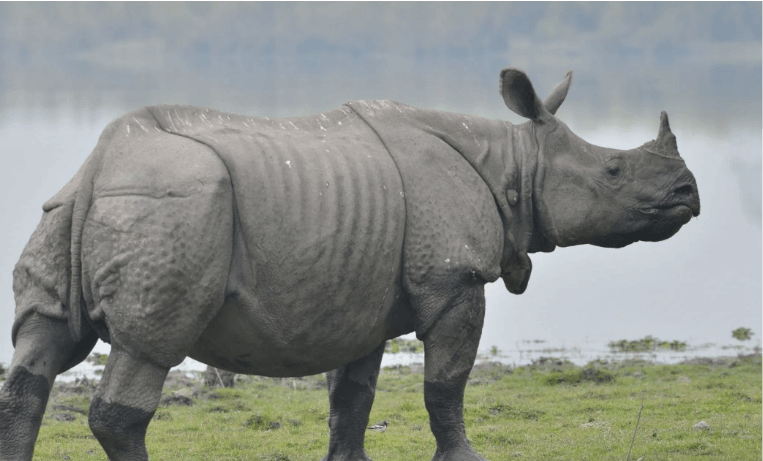
Kaziranga National Park is the home of the rare one-horned Indian rhinoceros (Unicorn). Situated at a distance of 217 km from Guwahati and 97 kilometres from Jorhat, this famous National Park has an area of 858 sq kms. Kaziranga lies partly in Golaghat and partly in Nagaon District.The Kaziranga’s landscape is of sheer forest, long elephant grass, bumpy reeds, sweet marsh and shallow pools. So far, the history of Kaziranga is worried before Lady Curzon that she heard about the Rhino of Kaziranga from her British tea planter friends and came to Assam in 1904-05.Though he could not see the animal,but the scraper print was seen with three toes. Which worried Lady Curzon was such a beast. On her return, he persuaded Lord Curzon to do something to save this animal from total destruction.Lord Curzon revived the wheels of British bureaucracy and announced the government’s intention on June 1,1905 to declare 57,273 60 acres of Kaziranga as a reserve forest.
After all Kaziranga was declared as reserve forest on January 3, 1908 and was officially closed for shooting on January 28th. In 1913, the area of reserved forest was expanded with an incorporation of 13,506 acres. Kaziranga was declared a ‘Game Sanctuary’ on November 10, 1916. In 1938, AJW Milroy, the then guardian of the forest, stopped all the victims and opened the Kaziranga to the visitors. Because the word ‘game’ tells the animals for hunting. In 1950, senior guardian of One PD Straccy changed the word to ‘Wildlife Sanctuary. Gradually the Sanctuary began as a small nucleus covering a small area, which expanded to the present size.
Finally, 11th in February, 1974, the designation was changed to Kaziranga.
National Park’ Wildlife: One Horned Unicorn, Elephant, Indian Bison, Swamp Deer Sambar, Hog Deer, Sloth Bear, Tiger, Leopard, Leopard Cat, Jungle cat, bog badger, Capped Langur, Hoolock Gibbon, Jackal, goose, Hornbill, Ibis, Cormorants, Egret, Heron Fishing Eagle etc. Many migratory birds go to Kaziranga in the winter season.
Kaziranga project came under Tiger on 3 August 2007 because it is the last living population of the tiger. It was also placed in the 1985 World Heritage Site for the unique combination of beautiful beauty and rare property of wildlife. According to the 2010 tiger census. Kaziranga has 32 tigers per 100 sq km, which is the world’s tallest tiger density.
Best Time to Visit:
Kaziranga Park is closed for visitors from 01 May to 31 October every year. Therefore, it is the best time to visit Kaziranga National Park from November to April.
Summer (April to May): During this time of year, the climate remains dry and airy; Anyone can find animals around the body of water.
Monsoon (June to September): From June to September, this region has heavy rains, about 2,220 millimeters (87 in). Thus the climate remains hot and humid. The park is closed from May to October due to the warnings of the Brahmaputra river flood.
Winter (November to February): Perhaps the best time to visit Kaziranga National Park as a season is light and dry. The possibility of burning grass is more in winter because the grass gets burnt and the background becomes clear.
Safari Timing:
Kaziranga Park Authority organizes a Jeep and elephant safari tour to promote wildlife tourism in Assam.
Morning Jeep Safari: 8:00 am to 10:00 pm
Afternoon Jeep Safari: 02:00 pm to 4:00 pm
Elephant safari time
Morning – 05:30 / 06:30
Morning – 06:30 / 07:30
Safari Gate / Jones
Spread over an area of 430 square kilometers, the park alka variety hotspot is divided into four areas; Each has its own distinctive characteristic about grasslands, mammals and density of birds, land topography, terrain.
Below are some points of pre-defined tourism circuits where jeep safaris are:
Mihimukh in the central range in Kohora
Bagori in the western range in Bagori
Agaratoli in Eastern Range in Agaratoli
Ghorakhati in Burapahar Range in Gorakhati
Official Website: Click Here
Dibru-Saikhowa National Park:
Dibru-Saikhowa National Park, spread over 340 sq km is One of the hot spots situated in the south bank of the river Brahmaputra in the extreme east of Assam. Biographically the area exhibits the properties of both the Indian and Malayan sub-regions. Dibru-Saikhowa is among the most vibrant wildness on earth.and is also distinct for her pristine scenic beauty. Situated in the flood plain of Brahmaputra, Dibru-Saikhowa is a safe haven of many rare and endangered species of wildlife. Dibru-Saikhowa National Park lies partly in Dibrugarh and partly in Tinsukia district. Of the seven parts of the park, one part is wetland and the rest is mainly grassland and dense forest It is 13 km from Tinsukia town which is 490 km from Guwahati. The government of Assam recognised it as a sanctuary which was previously known as Dibru-Saikhowa Forest Reserve. It is known as the primary habitat of the white-winged wood duck, commonly known as Deo Hanh.
This area was declared Dibru Reserve Forest in 1890. The additional area was added to the Dibru Reserve Forest in 1920 and 1933. In 1929, the Saikhowa Reserve Forest was declared.
It was declared jointly by Wildlife Sanctuary (650 km2) by the Assam Government by combining two reserve forests, such as Dibrugu and Sakhova, along with some other areas in 1986. In 1997, the Dibru-Saikhowa Biosphere Reserve was declared as an area of 765 km2, in which 340 km 2 sanctuary was included as the core.
In 1999, the Dibru-Sakhova Wildlife Sanctuary was declared a National Park. The total area of the park is approximately 340 km2. In the past the park was originally designed to help save the residence of rare white-winged wood ducks.
Wildlives:
Various species of monkey, land and aquatic bird and snake; deer, wild pig, tiger etc. On 91″ March, 1999 the central government recognised it as a National Park. This is the only forest reserve of the world where wild horses are found. At present there are about 100 wild horses in it.
Best Time to Visit:
Dibru-Saikhowa National Park is generally open for tourists from November to April, or notified by the National Park Authority. A written permission from the Park Authority for entering into the National Park is obligatory.No entry after sunset and before sunrise is permitted in the Park. Night halts and picnicking are strictly prohibited inside the park. Lodging facilities are available outside the park in Guijan One IB. For which advance booking is necessary.
However, private Hotels are also available at Tinsukia Town at a very reasonable rate.
Where to stay:
1) Divisional Forest Officer, Wildlife Division, Tinsukia, Phone: +91-374-331472(O) 333082(R)
2) Guijan Forest I.B.,
How to reach:
By road: Tinsukia is the nearest city, which is approximately 10 km and 50 km away from Gujjan and Dhola entrance point respectively. Anyone can take buses, auto rickshaws and taxis from Tinsukia. Park is 500 km from state capital Guwahati.
By Rail: The nearest railway station is also at Dibrugarh which is linked with Guwahati by a broad gauge.
By Air: The nearest airport to the park is at Dibrugarh, which is located at a distance of 40 km from Tinsukia.
Official Website: Click Here
Manas National Park:
Manas National park, spread over 500 sq km was recognised as a sanctuary in 1922 In 1973 it came under Project Tiger as it houses the last surviving population of tiger. It was also placed in World Heritage Site in 1985 for its unique combination of scenic beauty and rare wealth of wildlife. It has the largest number of rarely found wild animals of India which includes 22 species of endangered animals.It was set up as a National Park in 1990. However tiger are not only wildlife to be found here. The rarest species of Manas are Hispid Hare, Pigmy Hog and Golden Langur.
Other commonly seen animals are elephant, Indian rhinoceros, wild buffalo, wild boar, sambar deer, hog deer etc. Hundreds of feathered species are transferred to the environmentally friendly environment during winter. Among them are river chats (white capped redstars),fortails,cormorants and various types of ducks including the ruddy shelduck. Woodland is less attractive to birds and includes Indian hornbill and Great Pied Hornbill. Manas is about 180 km from Guwahati.
Best Time to Visit:
The best time to visit Manas National Park is from November to April. The weather is pleasant and more likely to find more organisms. The park is open every six months, unless for exceptional reasons like rain or safety.
However, the park has partially opened in the months of May and October. Since June to September is the period of monsoon,the park is closed
How to reach Manas:
BY ROAD
Manwa is 176 kilometres away from Guwahati. National Highway No. 31 Barpeta Road (not Barpeta City) which is connected to 22 KM (Manas entrance point where Musa is located near Jungle Retreat Park) for Bansbari.The journey to Guwahati from the road is 5 hours around.
BY RAIL
Guwahati is the gateway to northeast India. All major cities of India are well connected to Guwahati along with Rajdhani Express. Several trains stop at Barpeta Road Railway Station, which is 22 km from Bansbari (Musazangal Retreat, Manas) on the road.
BY AIR
The nearest airport is Guwahati (about 180 km / 5 o’clock drive). Regular flight operates from Bagdogra, Kolkata, New Delhi, Mumbai, Bangalore, Chennai, Jaipur, Hyderabad, Goa, Dibrugarh, Jorhat by Air India, Jet Airways, Jet Lite, Indigo and Go Air Drukair connects Bangkok and Paro (Bhutan) twice a week with Guwahati.
Manas National Park Tourism
Manas National Park Tourism offers various activities to visitors to enjoy and appreciate the variety of nature.
1.Jeep Safari
Manas National Park is home to more than 20 endangered species of birds and animals. Gets the rare sight of the animals of the Alien Manas Wildlife Sanctuary including Assam Roof Turtle, Piggy Hog and Green Green. Beautiful raw surroundings will make you feel tremendous love for nature.
Timings: 09 AM – 12 PM and 02 PM – 05 PM
2. Elephant Safari
Riding through the park by riding on the back of an elephant MANAS National Park is another interesting way to find animals. These grand giants are part of National Park. Elephant Ride gives you access to areas of the park where Jeep is not allowed. You get a different perspective of the park from sitting back of a pachyderm.
Price: Rupees 500.00 for Indians, Rupees 1,550.00 for foreigners.
Timings: 6:00 AM, 7:00 AM
3. River rafting
For the adventure seekers and wildlife enthusiasts, river rafting on the slow water of Manas river is an exciting experience. A 35 km ride takes you through wild deciduous forests, which is home to 400 different species of birds. Rafting on the water of the river’s deep forest is an experience you really need to see.
Official Website: Click Here